
Practice Areas / Defamation
Defamation Lawyers
Advice for people and businesses who have been defamed, and for those accused of defamation, across Melbourne, Frankston and the Mornington Peninsula. Advice in English and in Polish.
Reputation, online and off
A false post, review or email can travel far and fast. So can a letter demanding damages over something you wrote. Defamation law in Victoria sets out formal steps, short time limits and real costs risks for both sides, which is why early advice matters.
We act for people and small businesses whose reputation has been attacked, and for individuals, businesses and page administrators facing a complaint. Radek Dajer handles each matter personally, and can advise in Polish, including on material published in Polish.
How we help with defamation

What a claimant must prove
Defamation in Victoria is governed by the Defamation Act 2005 (Vic), which follows national model provisions, together with the general law. In Victoria, defamation claims are usually brought in the County Court or the Supreme Court.
- Publication: the material was communicated to at least one person other than the person it is about.
- Identification and meaning: it identifies you, and it carries a meaning that would lower you in the estimation of ordinary, reasonable people.
- Serious harm: the publication has caused, or is likely to cause, serious harm to your reputation. A judge decides this, and can decide it before trial.
- Businesses: a company can sue only if it is a not-for-profit body, or has fewer than 10 employees and is not associated with another company, and it must show serious financial loss. The people behind a business may be able to sue in their own right.
Concerns notices and time limits
Defamation has its own process before proceedings. A claimant cannot sue until a concerns notice has been given and the publisher has had time to make an offer to make amends.
- Concerns notice: must be in writing, say where the material can be found, set out the meanings complained of and describe the serious harm. A copy of the material should be included if practicable.
- Waiting period: proceedings generally cannot start until 28 days after the notice is given. The publisher can ask for further particulars, which must be provided within 14 days.
- Offer to make amends: can include a correction, an apology, removal of online material and compensation. A reasonable offer that is refused can give the publisher a defence.
- One-year limit: under the Limitation of Actions Act 1958 (Vic), proceedings must generally start within one year of publication, counted from when online material was first uploaded. A court can extend this to up to three years only if it is just and reasonable.
The clock starts at publication
The one-year period runs from the date of publication, not from when you found out. A concerns notice given in the final 56 days extends the period, but only by a calculated number of days. Act early, and keep screenshots showing the material, the date and the web address.
Online publications and defences
Since 11 September 2024, the Defamation Act 2005 (Vic) has included reforms for material published online, often called the stage 2 reforms. They change who is liable for other people’s posts and how anonymous posters can be identified.
- Digital intermediaries: platforms, website operators and people who run online forums or pages have a defence for material posted by others, if they have an accessible complaints mechanism and take reasonable steps to remove or block it within 7 days of a proper complaint.
- Search engines and technical services: caching, conduit and storage services, and search engines for their search results, are exempt from liability in defined circumstances.
- Anonymous posters and removal orders: a court can order information that helps identify a poster, after weighing privacy and safety, and can order a platform that is not a party to remove material once an injunction or judgment is obtained.
- Defences: the main defences include truth, contextual truth, honest opinion, qualified privilege, public interest, innocent dissemination and absolute privilege, which now covers reports made to police.
How our fees work
- Before we start work, we tell you in writing how we will charge and give you an estimate of the costs.
- Where the work allows, we quote a fixed fee.
- Otherwise we charge for the time spent, and the written estimate tells you what to expect.
- Court fees, search fees and other amounts paid to third parties are shown separately.
- If the estimate changes significantly, we tell you in writing.
Worried about something published?
Book a consultation and bring copies or screenshots of the material, with dates and web addresses. We will advise on your position, your next steps and the time limits that apply.
We reply to every enquiry within one business day, by phone, email or text, whichever you prefer.
What happens next
- Send the form.
- We reply within one business day.
- We arrange a time to talk, or ask for any information or documents we need first.
Prefer to talk? Call 1800 776 529.
Common questions
Can’t see your question? Call 1800 776 529 or send us a message.
Possibly, if the review carries false and defamatory meanings and causes serious harm. A genuine opinion on a matter of public interest, based on proper material, may be protected by the honest opinion defence. A company can sue only if it is a not-for-profit or has fewer than 10 employees and is not associated with another company, and it must show serious financial loss. A complaint to the platform is often quicker, because the platform needs to act on a proper complaint to rely on its own defence.
Do not respond publicly before getting advice. Keep a copy of what was published, where and when, even if you decide to take it down. Check whether you have received a formal concerns notice, because the time for an offer to make amends runs from that notice. A prompt and reasonable offer, which may include a correction, an apology or removing the material, can resolve the dispute and may give you a defence.
No. Under the Defamation Act 2005 (Vic), an apology is not an admission of fault or liability and is not admissible as evidence of liability. A prompt apology can also reduce any damages. The wording still matters, so it is worth getting advice before you publish one.
It depends on the seriousness of the harm. Damages for non-economic loss are capped at a maximum that is adjusted each year and reserved for the most serious cases. Aggravated damages can be awarded separately, and proven financial loss can be claimed in addition, but exemplary damages cannot be awarded. Legal costs can be significant, so we weigh them against what you could realistically recover.
It may be possible. A court can order a platform or another party to provide information that helps identify the poster, so that a concerns notice can be given or a claim started. Before making the order, the court must consider privacy and safety, including any risk of family violence. The platform’s own complaints process may also resolve the problem faster.
Truth is a complete defence to defamation. Publishing private information may instead give rise to a claim under the statutory tort for serious invasions of privacy in Schedule 2 of the Privacy Act 1988 (Cth), which commenced on 10 June 2025. It has its own elements, defences and short time limits, so get advice early.
Dispute insights

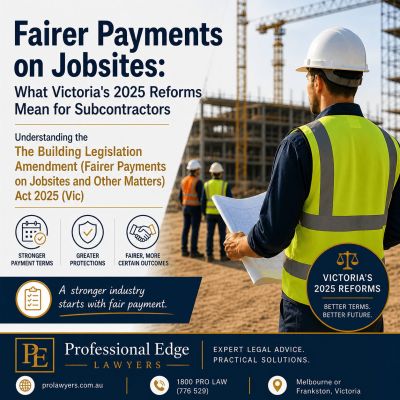

Getting paid on time has always been one of the biggest problems for subcontractors in Victoria’s building and construction industry….

Victoria’s building laws changed significantly on 1 July 2026. Learn what the new buyer protections, Home Warranty reforms and rectification orders mean for homeowners.

Thinking about taking someone to court in Victoria? This plain-English guide explains which court to use, how costs work, what alternative dispute resolution involves, and what to expect from civil litigation.

Discovering defects in your new home or renovation is stressful and expensive. Victorian law provides protections for home owners against defective building work.
When a debtor fails to pay, knowing the correct legal steps can mean the difference between recovering your money and writing off the debt entirely.