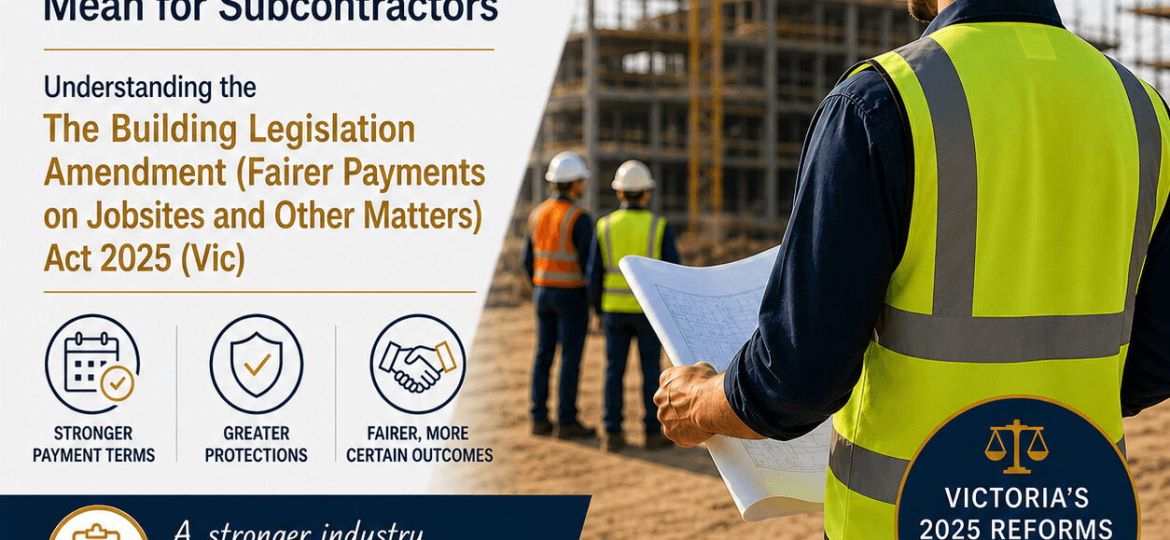
Getting paid on time has always been one of the biggest problems for subcontractors in Victoria’s building and construction industry. As of 15 April 2026, the Building Legislation Amendment (Fairer Payments on Jobsites and Other Matters) Act 2025 (Vic) has changed that. The reforms are now in force, and they apply not only to new contracts but retrospectively to construction contracts already on foot.
This is the most significant overhaul of Victoria’s Security of Payment regime since the legislation was first introduced in 2002. In this article, we explain what the new laws do, why they were introduced and, most importantly, what you as a subcontractor should be doing right now.
What is the Fairer Payments on Jobsites Act?
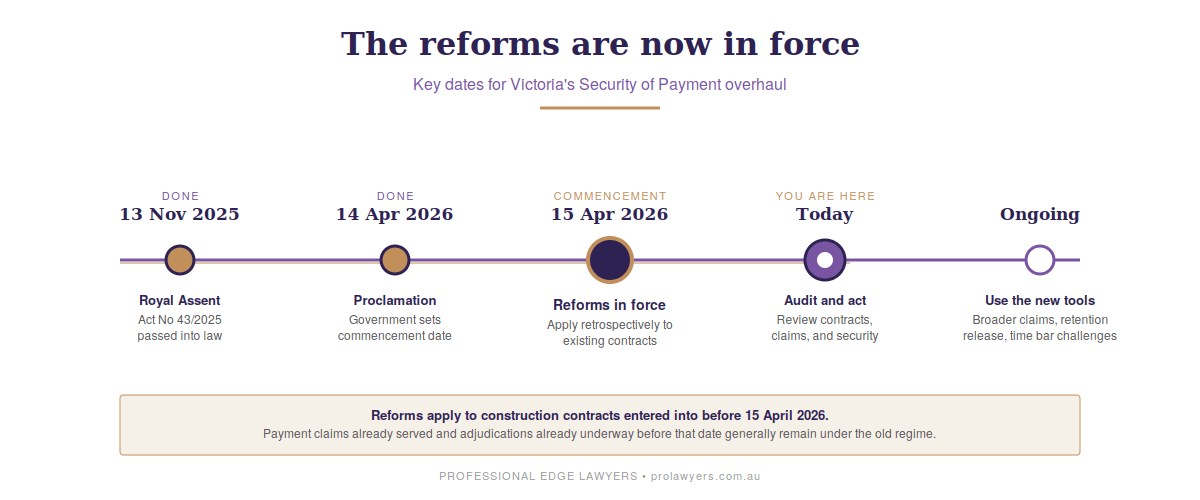
The 2025 Act amends a number of Victorian building laws, most importantly the Building and Construction Industry Security of Payment Act 2002 (Vic) (the SOP Act). It received Royal Assent on 13 November 2025 as Act No 43 of 2025, the Victorian Government proclaimed commencement on 14 April 2026, and almost all of the Part 2 amendments to the SOP Act took effect the following day.
The reforms plug into the existing Security of Payment framework. You still make payment claims. Respondents still have to issue payment schedules. Adjudication is still the fast-track process to resolve payment disputes. What has changed are the rules around what you can claim, how long you can be made to wait, how performance security and retention are treated, and how disputes are run through adjudication.
For subcontractors, this is significant. You now have clearer statutory backing for payments you previously may have struggled to recover under contract alone.
Important to know: the changes apply retrospectively to construction contracts entered into before 15 April 2026. The exception is that payment claims already served under the old SOP Act, and adjudication applications already made but not yet determined as at 15 April 2026, generally remain under the old regime. For everything else, the new rules apply now.
Why did the government change the law?
These reforms did not come out of nowhere. They follow a Victorian parliamentary inquiry into employers and contractors who refused to pay their subcontractors for completed works. The inquiry’s November 2023 report made 28 recommendations, of which the 2025 Act implements 15 in full as the first tranche of reform. A second tranche, including reforms to extend SOP coverage to homeowner contracts, remains under consultation.
The inquiry found that, in practice, many subcontractors:
- were forced to accept long payment terms and delayed release of retention;
- struggled to get paid for variations, delay costs and other “complex” claims;
- found it difficult to use Security of Payment where retention or performance security was involved; and
- were out-gunned in adjudication processes by more sophisticated principals and head contractors.
The government’s response set out to improve the industry’s ability to recover payments, modernise the Security of Payment process, and bring Victoria into line with reforms that already operate in other states. The 2025 Act delivers that response.
For you on site, the policy message is simple. The law has moved in your direction. You still need to comply with strict procedures, but the statutory framework is now more favourable to subcontractors than it has ever been.
Stronger rights to be paid: what has actually changed?
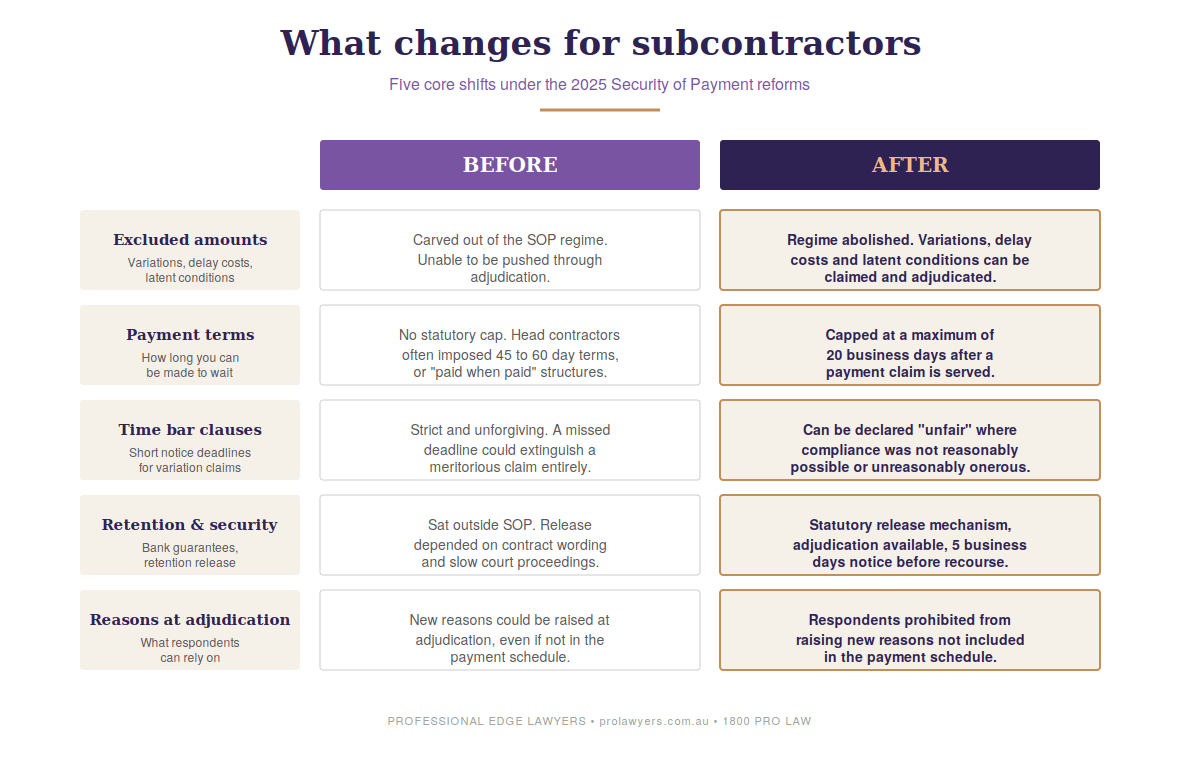
From a subcontractor’s perspective, the biggest changes fall into four broad categories: what you can include in a payment claim, how long you can be made to wait, how performance security and retention are treated, and how disputes are run through adjudication.
Broader scope of what you can claim
Previously, Victoria had a unique “excluded amounts” regime. Certain types of claims, such as some delay costs, latent condition claims and certain variations, were carved out of the Security of Payment process. You might have done the work, incurred the cost and issued a claim, only to find you could not push that claim through adjudication.
The reforms abolish the excluded amounts structure and the related concept of “claimable variations”. The scope of what counts as a payable amount under the SOP Act has been widened. You can now include a broader range of claims in your payment claim and have those claims determined by an adjudicator, including delay damages, latent condition claims and disputed variations.
For subcontractors, this means you are no longer easily shut out of adjudication just because your claim is “complicated” or labelled as a delay, variation, or latent condition claim. If it arises from construction work or related goods and services under your contract, it is far more likely to be captured by the statutory scheme.
Caps on payment terms
Long payment terms have historically pushed risk down onto subcontractors, particularly where head contractors insist on 45 to 60 day terms or link your payment to when they are paid by the principal.
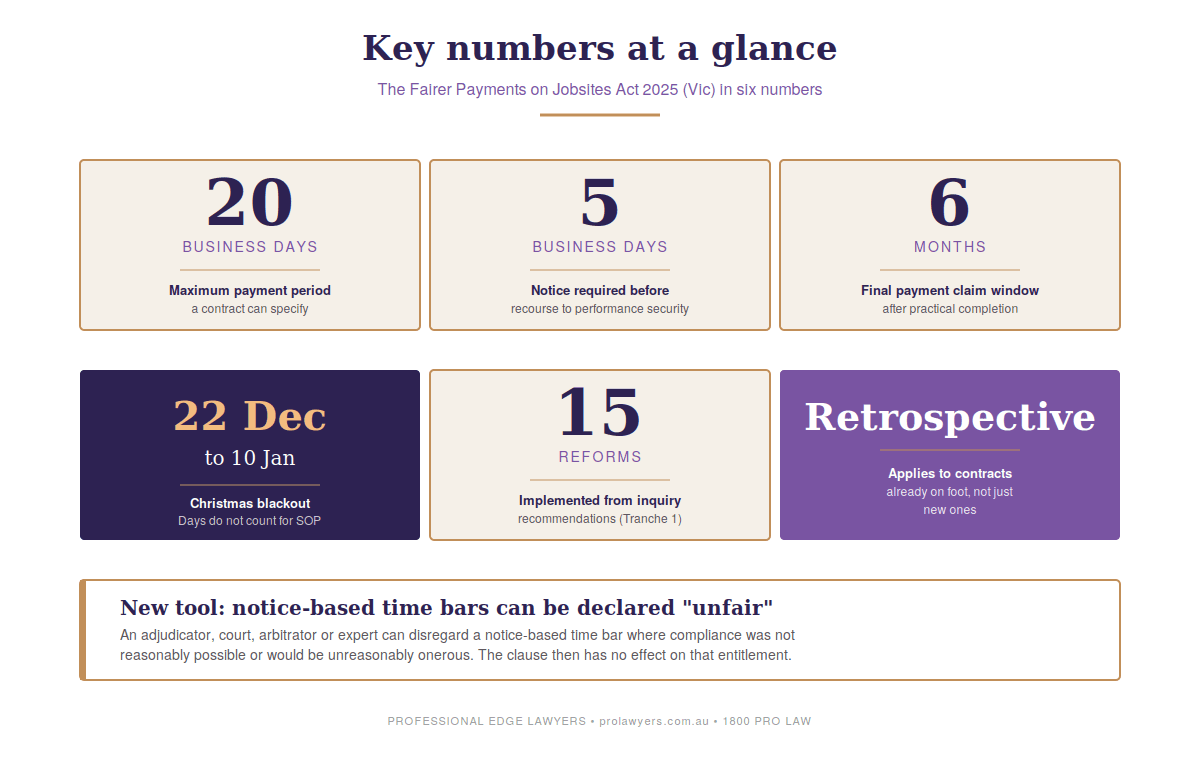
The reforms cap the maximum payment period a construction contract is allowed to specify at 20 business days after a payment claim is served. Where a contract attempts to set a longer period, the statutory cap will apply. The practical effect is shorter and more predictable timeframes for when your invoices and payment claims must be paid. This brings Victoria into line with the position in New South Wales and Queensland.
Notice-based time bar provisions can be declared unfair
This is a powerful new tool that subcontractors have not had before. Many head contracts contain notice-based time bar clauses that require very short notice of any claim for variations, delay costs or extensions of time, and treat the claim as lost if the notice is even a day late.
Under the reforms, an adjudicator, court, arbitrator or expert can declare such a clause unfair in relation to a particular entitlement, where compliance with the clause was not reasonably possible or would be unreasonably onerous. If declared unfair, the clause has no effect on that entitlement in the relevant proceeding.
In practical terms, you may be able to pursue a meritorious claim that would previously have been barred by a missed notice deadline. This will not save sloppy claim administration, but it does mean genuinely impractical contractual deadlines no longer act as an automatic kill switch.
Christmas shutdown protected
The reforms amend the definition of “business day” to create a blackout period from 22 December to 10 January each year. Days in this window do not count as business days for SOP purposes. This recognises the reality of the Christmas shutdown across the building industry and prevents claims and adjudication timeframes from being run down while everyone is on leave.
Performance security and retention: a major win for subcontractors
Retention and performance security have always been sore points for subcontractors. You may have a percentage of each progress payment withheld as retention, a bank guarantee or insurance bond held as performance security, and contract terms that let the principal or head contractor hold onto that security long after you finish your work.
Historically, there has been considerable uncertainty about how retention and security interact with the SOP Act. The 2025 reforms create a clear statutory framework, including:
- a dedicated regime allowing any party who has provided performance security under a contract to claim its release through the SOP framework. The definition of “performance security” is broad and includes both performance bonds and retention money, putting to rest the long-running debate about whether retention sits within the Act;
- the ability to refer disputed performance security claims to adjudication or court;
- a requirement for the holding party to give at least 5 business days’ written notice of intention to have recourse to a performance security before drawing it down;
- a statutory framework for claiming release after the defects liability period (DLP), which the Act defines as the period from practical completion until required rectification work is completed; and
- potential interest on undelivered security release, calculated at the greater of the rate under the Penalty Interest Rates Act 1983 (Vic) or the rate specified in the contract.
For subcontractors, this is a genuine shift in power. You are no longer entirely dependent on the contract’s wording or the goodwill of the head contractor to see your retention released. If you have completed your obligations and the contractual conditions for release have been met, you can bring that into the Security of Payment space.
This means you can:
- structure payment claims that include retention release where appropriate;
- challenge unfair calls on your bank guarantee more effectively, with at least five clear business days to act; and
- bundle retention or security release with other outstanding amounts in a structured statutory claim.
It also encourages better behaviour upstream, because principals and head contractors know that their decisions around security are now subject to fast-track adjudication scrutiny, not just slow and expensive court proceedings.
How claims and adjudications now work in practice
While the core idea of Security of Payment remains the same, the 2025 Act modernises how claims and adjudications operate.
“Reference dates” abolished
The “reference date” concept has been the subject of years of litigation about whether and when a claimant had a right to make a progress payment. The reforms remove that concept and replace it with clearer rules about when payment claims can be made.
The reforms also extend the time within which a final claim can be made after completion of the work to at least 6 months after the date of practical completion, up from 3 months under the old regime. A payment claim served before the relevant due date will still be valid, reversing earlier case law that struck out “early” claims. Importantly, claims that might have expired before 15 April 2026 may now be available again under the new long-stop.
No new reasons at adjudication
This change is one of the most important for subcontractors in practice. Respondents (typically principals and head contractors) are now restricted from raising new reasons at adjudication that were not included in their payment schedule. The same principle applies in relation to performance security schedules.
Practically:
- if a head contractor wants to dispute your claim for payment, or for the release of retention or security, it must say why and do so in writing within the statutory timeframe (10 business days for a payment schedule);
- it cannot hold back additional reasons to spring on you later in adjudication.
For subcontractors, this levels the playing field. You see the full case early. You can prepare your adjudication application knowing what you are actually arguing about. It rewards claimants who issue clear, well-documented claims, and puts pressure on respondents to take their scheduling obligations seriously.
Adjudication remains a “pay now, argue later” tool
The reforms tighten some adjudication procedures and the enforcement of determinations. The broad effect is that adjudication continues to be a relatively fast and low-cost mechanism, determinations remain enforceable as court judgments if the respondent does not pay, and there is less scope for drawn-out review or re-litigation of an adjudicator’s decision.
There is no requirement to pay the adjudicated amount before seeking judicial review. The “pay now, argue later” structure is preserved, but the runway around it is now much friendlier to claimants.
What subcontractors should be doing now
These reforms are good news, but they will not help you unless your business practices and contracts align with the new regime. Because the changes are now in force and apply to existing contracts, the time to act is now.
1. Review your existing contracts
Take a close look at your standard subcontract terms and any head contracts you regularly sign. In particular, identify clauses that:
- set payment terms longer than 20 business days;
- delay release of retention or performance security;
- tie your payment to final certificates or to the head contractor being paid;
- contain short notice-based time bars for variations or delay claims;
- do not clearly set out when and how you can make claims.
Several of these clauses may now be unenforceable, capped, or vulnerable to challenge as “unfair”. Because the reforms apply retrospectively, this matters for contracts already on foot, not just new ones you sign tomorrow.
2. Revisit any claims you thought had expired
Because the long-stop date for final payment claims has been extended from 3 months to 6 months after practical completion, some claims that had timed out under the old regime may now be back on the table for any payment claim served on or after 15 April 2026. If you have unpaid amounts on a recently completed project, do not assume the door has closed without taking advice.
3. Upgrade your payment claim process
Because respondents can no longer save up new reasons for adjudication, getting your claims right from the start is now even more important. Consider:
- using a standard template that clearly states the document is a payment claim under the Building and Construction Industry Security of Payment Act 2002 (Vic);
- listing each item of work, variation, delay cost or security release you are claiming, with a reference to the contract clause and supporting documentation;
- keeping tight records of when claims are served, how, and to whom (email, post, hand delivery).
Better claim discipline will not just reduce disputes. It will put you in a stronger position when a dispute does arise.
4. Respond quickly to payment schedules
If you receive a payment schedule that under-values your claim or proposes to withhold retention, you must act within the statutory timeframes for adjudication. Those timeframes remain unforgiving. Make sure your contract administration systems track when payment schedules arrive, flag any discrepancies between claimed and scheduled amounts, and trigger an internal process to consider adjudication promptly. Missing a deadline can still mean losing the chance to use Security of Payment for that claim.
5. Use the new security and retention tools
Do not assume retention and performance security are off limits for Security of Payment. Under the 2025 reforms, they are squarely within the framework. Examples of where you might now use the Act include:
- seeking release of retention when you have reached practical completion or the end of the defects liability period and the contract criteria are met;
- challenging a threatened call on your bank guarantee where you believe it is unjustified, using the new 5 business day notice as a window to act;
- bundling retention or security release with other outstanding amounts in a structured statutory claim.
Handled properly, this can significantly improve cash flow and reduce the long-term drag that retention places on a subcontracting business.
How Professional Edge Lawyers can help
The Fairer Payments on Jobsites reforms are a major shift in Victoria’s Security of Payment landscape. They create real opportunities for subcontractors to get paid faster, recover more types of claims, and unlock retention and performance security earlier. They also introduce new technical requirements and strict deadlines, and they apply retrospectively to contracts already in place.
We assist subcontractors and small to medium contractors across Frankston, Melbourne and the Mornington Peninsula by:
- reviewing and updating subcontract templates to comply with the amended SOP Act;
- advising on payment terms, retention and security clauses in new and existing projects;
- preparing or reviewing payment claims and payment schedules;
- acting in adjudications, including claims for unpaid progress payments and for the release of retention or performance security;
- defending or challenging calls on bank guarantees and other performance security; and
- advising in relation to disputes overseen by the Building and Plumbing Commission (BPC), Victoria’s new building and plumbing regulator.
If you are unsure how the 2025 reforms affect your current contracts or outstanding claims, or if you are facing a dispute about payment, retention or security, getting early advice can make the difference between a quick recovery and a long-running dispute.
To discuss your situation, contact Professional Edge Lawyers on 1800 PRO LAW (776 529) or email info@prolawyers.com.au. You can also read more about our work in this area on our Practice Areas page or get in touch via our Contact page.
Subcontractor or builder? See our building and construction lawyers page for payment claims, security of payment and building disputes, or call 1800 776 529.
This article is general legal information only. It is not legal advice and should not be relied upon as such. The Building Legislation Amendment (Fairer Payments on Jobsites and Other Matters) Act 2025 (Vic) is complex and its application depends on specific facts, dates and contract terms. You should obtain advice tailored to your circumstances before acting on any of the matters discussed.
Need Legal Advice?
Practical advice from our Frankston office for clients across Melbourne and the Mornington Peninsula, in English or in Polish.
BOOK A CONSULTATION1800 776 529
Related Insights

Victoria's Building Law Overhaul: What Homeowners Need to Know in 2026