
Legal insights
Plain-English guides to Victorian law from our Frankston office: property, business, disputes, family, wills and estates, and notarial work.
Latest articles
Updates on changes to the law, and step-by-step guides to common legal matters in Victoria. Each article is general information only, not advice about your situation. For advice, talk to us.

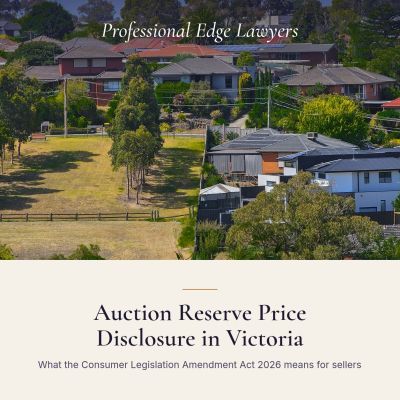

Updated 12 October 2026: the reserve price rules in the Consumer Legislation Amendment Act 2026 (Vic) (Act No 36/2026) now…
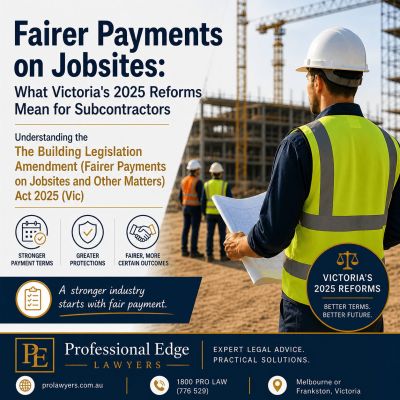
Getting paid on time has always been one of the biggest problems for subcontractors in Victoria’s building and construction industry….

If you were in a serious accident tomorrow and could not speak for yourself, who would decide whether doctors could…

When someone dies without a valid will in Victoria, their estate does not automatically pass to their family. Before any…

From 1 January 2025, intentional wage theft is a criminal offence in Australia. Learn what the new laws mean for employers, what penalties apply, and what steps you should take now.

A notary public certifies documents for use overseas. Learn what a Victorian notary does, when you need one, what an apostille is, and how a notary differs from a Justice of the Peace.

Thinking about taking someone to court in Victoria? This plain-English guide explains which court to use, how costs work, what alternative dispute resolution involves, and what to expect from civil litigation.

Australian directors owe clear legal duties under the Corporations Act 2001. Learn what those duties are, what the business judgment rule means, and how to avoid personal liability.

Victoria’s building laws changed significantly on 1 July 2026. Learn what the new buyer protections, Home Warranty reforms and rectification orders mean for homeowners.
Buying a home is one of the most significant financial decisions you will make. A conveyancing lawyer guides you through contracts, Section 32 statements, stamp duty, and settlement.
More than half of Australian adults do not have a valid will. If you die without one, Victorian law decides who receives your assets, not you.
Discovering defects in your new home or renovation is stressful and expensive. Victorian law provides protections for home owners against defective building work.
Talk to us about your matter
Tell us briefly what has happened or what you are planning. We will explain your options, the next steps and how we charge. Call 1800 776 529 or send us a message, Monday to Friday, 9 am to 5:30 pm.