
Updated 12 October 2026: the reserve price rules in the Consumer Legislation Amendment Act 2026 (Vic) (Act No 36/2026) now apply to auctions and fixed date sales held on or after 16 October 2026. Consumer Affairs Victoria has confirmed the later start dates: 1 June 2027, 1 July 2027 and 1 December 2027. This article now states each of them.
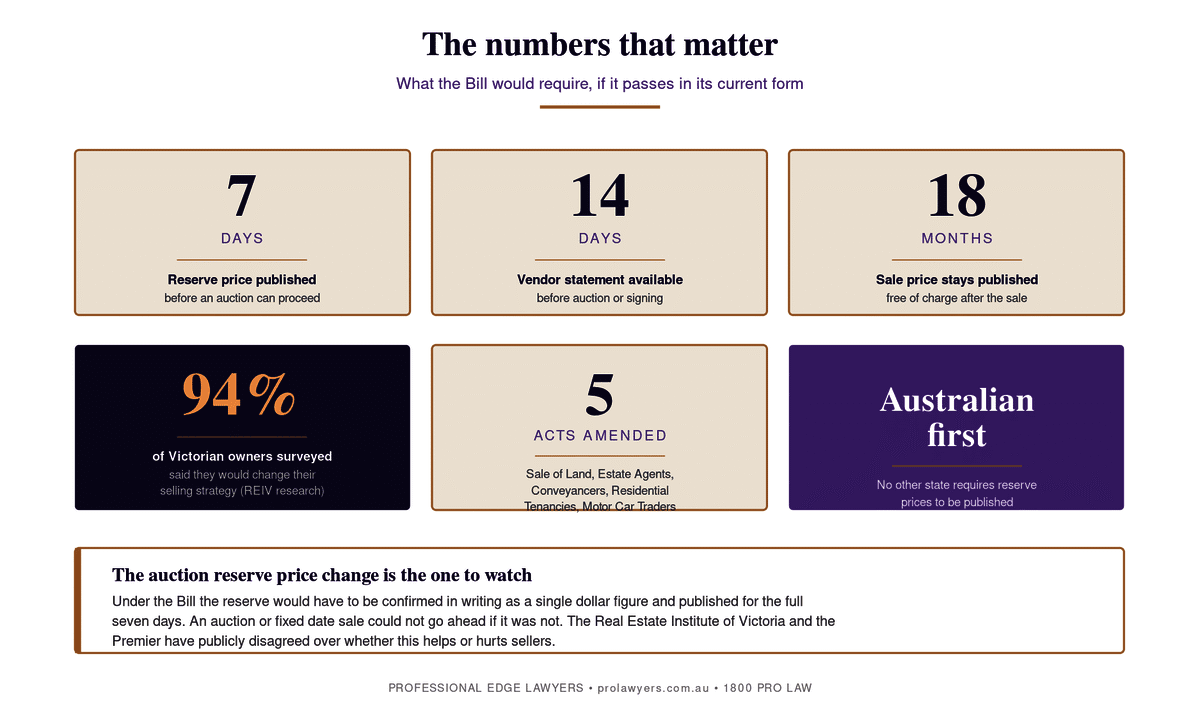
For residential auctions and fixed date sales held by an estate agent in Victoria on or after 16 October 2026, the seller’s reserve price, the lowest figure they are willing to accept, must be published at least seven days before the auction.
That is the headline change in the Consumer Legislation Amendment Act 2026 (Vic). It is the first law of its kind in Australia, and it is one of several changes the Act makes to how property is sold in Victoria. Some start on 1 October 2026; others start in 2027.
This article explains each change, when it starts, and what it means in practice.
Key dates at a glance
| Date | What starts |
|---|---|
| 1 October 2026 | The property price statement replaces the statement of information. Sold prices go on the statement within 7 days of an unconditional sale and stay public for 18 months. |
| 16 October 2026 | Reserve price published at least 7 days before auctions and fixed date sales; comparable property rules apply. |
| 1 June 2027 | Section 32 vendor statement available earlier: 14 days before an auction or fixed date sale. |
| 1 July 2027 | Early deposit release only if the contract allows it. Agents cannot take commission from the deposit. |
| 1 December 2027 | Agents give sold price information to the Director of Consumer Affairs Victoria. |
Source: Consumer Affairs Victoria, checked 12 October 2026.
What the Act is
The Consumer Legislation Amendment Act 2026 (Vic) is an omnibus Act. It amends several Acts, including the Sale of Land Act 1962 (Vic) and the Estate Agents Act 1980 (Vic), as well as laws dealing with conveyancers, residential tenancies and motor car traders. This article deals with the changes that affect people selling property.
The headline change: publishing your auction reserve price
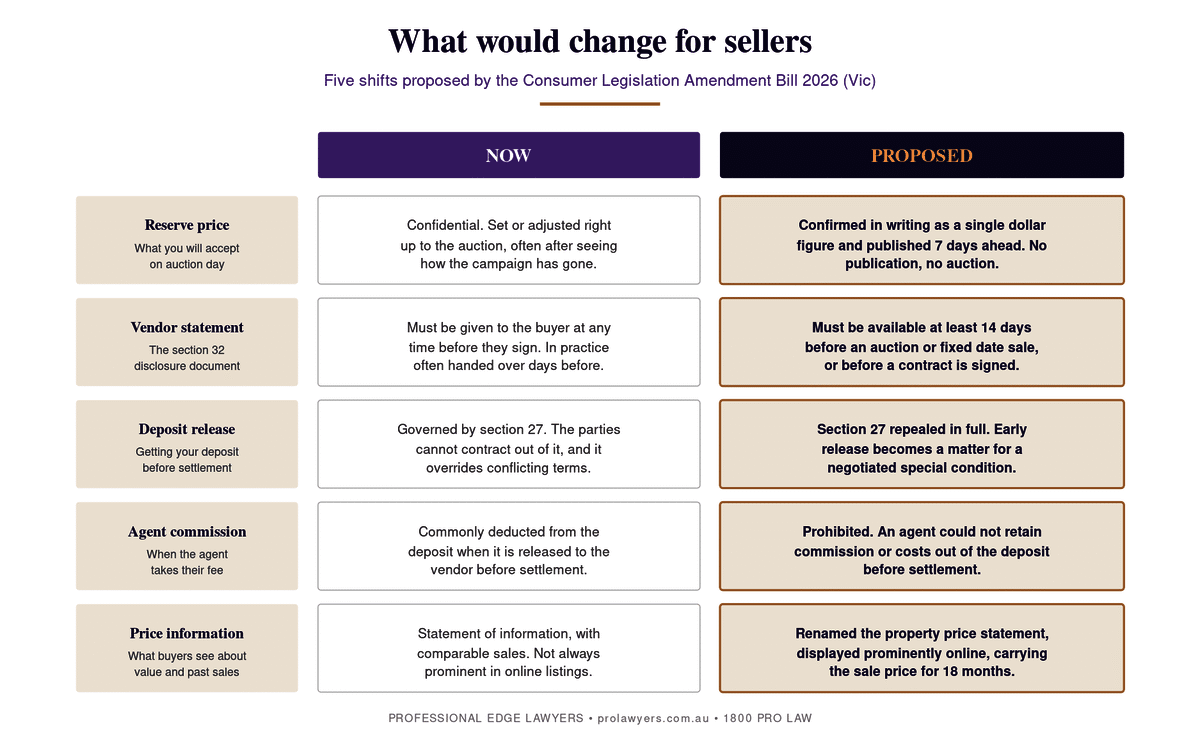
From 1 October 2026, when residential property is sold by an estate agent at auction or by fixed date sale, the reserve must be expressed as a single dollar amount and published for at least seven days before the auction or sale date. The rule applies to auctions and fixed date sales held on or after 16 October 2026. For an auction on 16 October 2026, the reserve had to be published by 9 October 2026; earlier sales follow the old rules. The reserve must be a single dollar amount, with no words or symbols such as “from”, “over” or “+”. If it is not published at least seven days ahead, the auction or fixed date sale cannot go ahead. Boardroom auctions and invited offers by a set date count as fixed date sales. The rule does not apply to commercial property or to private sales without a fixed date.
This is a real change to how Victorian auctions work. Until now the reserve has been confidential, and a seller could set it, or move it, right up until the auctioneer started. Most sellers did exactly that: they watched the campaign, counted the contract requests, gauged the crowd, and settled on a number the morning of the auction or in the room itself.
Under the new law you commit to a figure at least a week out, in public. If the reserve is changed after it has been published, up or down, the seven day period starts again. Online advertising must be updated within one business day after the agent receives the reserve. Settle the figure with your agent and your lawyer before it goes out.
The stated aim is to stamp out underquoting. Buyers who repeatedly attend auctions for properties advertised well below what they eventually sell for lose both money on inspections and faith in the process.
Why it was contested
The Real Estate Institute of Victoria opposed the measure, arguing that sellers would move to private sale, that reserves nominated early would be set high, and that clearance rates would fall. It proposed an alternative based on an advertised price range. An RMIT economist also questioned whether the rule would work, pointing out that publishing a reserve will not stop homes selling far above it. The industry did not defend underquoting; the disagreement was about the remedy.
What the auction reserve price rule means for you
If you are selling by auction once the rule applies, three things follow.
Your reserve becomes a decision you make a week out, with less information than sellers had before, and your ability to change it is limited. Setting it well becomes a more consequential piece of advice than it used to be.
Your negotiating position changes. Every buyer knows your floor. Whether that costs you depends on the property and the market, and reasonable people disagree about it.
Private sale becomes relatively more attractive for some sellers. That is not a recommendation, and it carries its own trade-offs, but it is a conversation worth having with your agent and your lawyer before you commit to a method of sale.
The property price statement
Also from 1 October 2026, the statement of information is replaced by the property price statement, and its role expands.
The property price statement and the indicative selling price must be shown prominently in online advertising, and other advertising must point buyers to it. The statement sets out the key features of the property and of each comparable property. If the agent cannot find three comparable properties but can find one or two, the statement must list those. Once a sale is unconditional, the agent must add the sold price to the property price statement within seven days, and it stays public for at least 18 months. A seller affected by family violence can apply to the Director of Consumer Affairs Victoria for an exemption.
From 1 December 2027, agents will also have to give sold price information to the Director of Consumer Affairs Victoria, unless an exemption is granted. Together, these provisions create a public record of what Victorian properties actually sell for.
The 14 day vendor statement rule
From 1 June 2027, the section 32 vendor statement must be available earlier in the campaign. For an auction or fixed date sale, it must be available at least 14 days before the sale. For a private sale, it must be available within 14 days after the property is advertised. If the property is not advertised, or will be sold within 14 days of being advertised, it must be available before the buyer signs.
Until then, the obligation is simply that the buyer must receive the statement before signing. In practice, statements are often finalised late in the campaign, and it is not unusual for one to be handed over days before an auction while a missing certificate is chased.
The 14 day rule ends that. The statement will need to be complete and available before the campaign is well underway, which in turn means the underlying work has to start earlier. Council certificates, title searches, owners corporation certificates and planning information all take time to obtain, and none of it can be rushed reliably.
Of all the changes, this is the one most likely to catch out sellers who leave their legal preparation until they have chosen an agent.
Section 27 goes, and agents lose access to the deposit
From 1 July 2027, section 27 of the Sale of Land Act 1962 (Vic) is repealed. Section 27 sets out how a vendor can obtain early release of the deposit before settlement. After the change, the deposit can be released before settlement only if the contract provides for it.
That is a meaningful shift. Section 27 gives sellers a statutory route to their deposit, available once the contract is free of conditions for the purchaser’s benefit and the purchaser has accepted title. Once it goes, the answer depends entirely on what was negotiated, which puts a premium on having the contract reviewed properly before it goes out.
From the same time, estate agents cannot take their commission from a deposit released before settlement. A seller can still choose to pay the commission before settlement. It has been common practice for an agent holding the deposit to deduct their fee before passing the balance to the vendor.
What else is in the Act
The Act also makes changes affecting conveyancers’ and estate agents’ licences, residential tenancies and motor car traders. Those changes are outside the scope of this article.
What sellers should do now
The reserve price rule applies to auctions and fixed date sales held on or after 16 October 2026, so if you are selling by auction this spring it affects you now. Three things are worth doing now.
Start your vendor statement earlier than you think you need to. The 14 day rule starts on 1 June 2027, and a section 32 assembled properly at the outset is the best protection against a buyer finding a reason to walk. An incomplete statement lets a purchaser rescind at any time before settlement.
Have the method of sale conversation early. If you are planning an auction in late 2026 or 2027, the auction reserve price rule is directly relevant to whether auction remains the right approach for your property. That is a decision to make with your agent and your lawyer, not one to discover three weeks out.
Get the contract reviewed, not just the disclosure. Once section 27 is repealed, deposit release becomes a negotiated term. Contracts that worked under the old default will not necessarily serve you under the new one.
How we can help
We act for sellers and buyers across Frankston, Melbourne and the Mornington Peninsula. On the changes discussed here, that means:
- preparing section 32 vendor statements early enough to meet the new disclosure timetable
- reviewing contracts of sale, including deposit release and special conditions
- advising on the practical consequences of the auction reserve price rule for your chosen method of sale
- acting on the sale or purchase through to settlement
- dealing with disputes where a buyer says the disclosure was defective
If you are planning to sell in the next 18 months, the preparation you do now is what determines whether these changes are a nuisance or a problem. Call us on 1800 PRO LAW (776 529) or email info@prolawyers.com.au. You can also read more on our Practice Areas page or get in touch through our Contact page.
Buying rather than selling? See our companion guide, Buying Property in Victoria: What Your Conveyancing Lawyer Does for You.
Selling or buying in Victoria? See our conveyancing lawyers page, and our competition and consumer law page for consumer protection matters, or call 1800 776 529.
This article is general legal information current as at 12 October 2026. It is not legal advice. Obtain advice on your own circumstances before acting.
Need Legal Advice?
Practical advice from our Frankston office for clients across Melbourne and the Mornington Peninsula, in English or in Polish.
BOOK A CONSULTATION1800 776 529
Related Insights

Buying Property in Victoria: What Your Conveyancing Lawyer Does for You

Fairer Payments on Jobsites: What Victoria's 2025 Reforms Mean for Subcontractors